Google Image search results related to climate change reflect prevailing views on the topic in a given country, rather than the actual level of climate risk local populations face, according to a new study.
The findings also suggest that accurate depiction of climate change in image search results could help drive changes in public sentiment. But right now, the algorithm is largely reflecting back to people what they already think about climate change, not telling them what they need to know.
Many people understand that platforms like Facebook and TikTok are not objective sources of information, says study team member Michael Berkebile-Weinberg, a postdoctoral researcher at Columbia Business School in New York. “On these apps, we know we’re getting highly curated feeds that are designed to show us exactly what we want to see, or at the very least designed to keep us engaged,” he says. “Many of us expect more objectivity from information-seeking platforms like Google Search. However, this doesn’t seem to be the case.”
Berkebile-Weinberg and his collaborators performed a Google Image search of terms related to climate change in 49 different countries and captured screenshots of the results. The image search results vary widely from country to country and reflect existing levels of climate concern in the country, the researchers report in the journal Nature Climate Change.
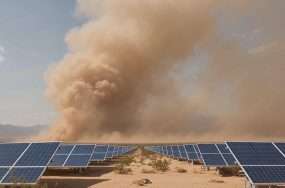
For example, image search in Argentina, where climate change concern is high, returns many images of burning homes, in line with the wildfires that have swept through the country in recent years.
In contrast, climate change concern is low in Estonia. There, search results feature distant images like icebergs and polar bears, or abstract ones like scientific charts.
In an online survey, the researchers showed each of nearly 400 participants a random sample of 20 image search screenshots. The participants consistently rated images from nations where people are already concerned about climate change as more emotional and more inspiring of a need for action compared to images from low-climate-concern countries.
But images don’t necessarily inspire emotion or a drive to action in countries that are most vulnerable to the effects of climate change. Essentially, the Google Image search algorithm is giving people what it thinks they want, and reinforcing what they already think about climate change.
In a second online survey, the researchers showed nearly 900 people the results of image searches conducted in either high- or low-climate-concern countries. Participants who saw images from searches in high-concern countries reported being more worried about climate change, more supportive of climate policies, and more inclined to take climate-friendly actions than those who saw images from searches in low-concern countries.
Surprisingly, the results did not depend on an individual’s political leanings. “We thought that more conservative individuals could possibly have a stronger reaction to seeing the more emotional images in particular due to their relatively surprising nature,” says Berkebile-Weinberg. “Turns out this isn’t the case, as across the political spectrum people perceived these images in similar ways.”
The finding that image search results can shape public sentiment represents both an opportunity and a risk. Right now, image search algorithms are merely reinforcing existing sentiments in society. In theory, accurate depiction of climate change in image search results could help increase public concern about climate change.
But image search algorithms could also be deployed to dampen climate concerns. “This potential for these search engines, and the algorithms working behind the scenes to run them, to stand in the way of real societal progress is an important problem for us to contend with,” says Berkebile-Weinberg. “We need institutions and organizations utilizing these technologies to develop tools that safeguard objectivity or at the very least inform users of the various insidious ways that harmful sentiments can be reproduced via these tools.”
Source: Berkebile-Weinberg M. et al. “Internet image search outputs propagate climate change sentiment and impact policy support.” Nature Climate Change 2024.
Images: Fire photo by Alexandre P. Juniord; Polar bear photo by Peter Prokosch/ GRID-Arendal