Situating solar panels on grasslands can boost grass growth by 20% on average—and as much as 90% in some areas—during dry periods.
This new research from Colorado in the United States suggests that solar panels could help to protect grassland ecosystems and increase biomass for livestock grazing in times of increasing drought under climate change.
One of the study’s two researchers has previously led research looking at the comparative energy-efficiency of solar panels on corn-for-ethanol farmland; this time he and his colleague wanted to examine the potential shading benefits of solar panels in the sun-drenched Western US grassland ecosystems. The region supports the livelihoods of millions of people who depend on grasslands for their grazing animals, so finding ways to boost biomass in this drought-vulnerable landscape is key.
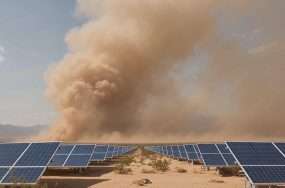
The researchers gathered data from a four-year experiment based at an agrivoltaics facility in Colorado, on an area of semi-arid perennial grassland. The facility contains single-axis solar panels that move as they follow the sun, which means that a cooler shadowed area below each panel moves from side to side across the grass. Over the four-year study period there were periods of high and low rainfall. At the end of each growing season, the researchers gathered samples of the grass at different points around each panel site.
The data revealed a clear and intriguing pattern: grasses that grew beneath and around solar panels typically showed more biomass compared to grassland in the control. The differences were striking, with some areas showing biomass increases of almost 90%.
The effect varied according to how much rainfall there was. While during rainy periods the growth differences between under-panel grasslands and the control was minimal, the researchers observed that during dry spells with full sun, the moving rectangle of shade made all the difference, shielding the grass from the worst of the sun’s effects, helping it to preserve water levels, and significantly boosting growth compared to the control grassland plots that were being scorched nearby.
The effect was larger in ‘edge’ areas particularly on the east but also the west side of each panel: these zones received a rectangular strip of shade for parts of the day as the solar panels moved to track the sun, and showed increased growth of 88% compared to control plots in full sun. This suggests that during dry periods particularly, grassland growth does best when it receives a mix of sunshine and shady relief.
“There have been several studies reporting improved plant and water relations from solar arrays,” said Matthew Sturchio, postdoctoral research associate at Cornell University and co-author on the paper with distinguished professor at Colorado State University, Alan Knapp, in a press release. “However, this is the first analysis that shows how that pattern becomes more pronounced with increasing aridity or dryness like we see in Colorado.”
Overall, across the whole experimental solar landscape, the researchers measured a 20% average increase in grass productivity during periods of particularly low rainfall.
With drought expected to increase worldwide, and particularly in grassland ecosystems, solar panels could provide some cool relief, increasing fodder for grazing livestock and so boosting agricultural security, but also restoring biodiversity in wild grasslands, the researchers say.
Pairing up energy production with grassland could therefore be a win-win, as solar panels seem to deliver on several landscapes. “Solar arrays may provide a unique opportunity to harvest the sun for electrical energy, reduce greenhouse gas emissions, and mitigate the climate change threat of increased water limitation,” the researchers write.
Sturchio, M. & Knapp, A. “Evidence of photovoltaic aridity mitigation in semi-arid grasslands.” Environmental Research Letters. 2025.
Image: Matthew Sturchio, CC BY-ND