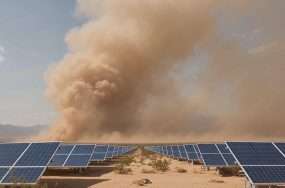
Open-pit mines around the world have enough room for solar panels to generate more than 4,700 terawatt hours (TWh) of electricity per year, according to a new study. The findings represent the first global analysis of an efficient new approach to renewable energy siting.
Solar power is growing fast in many countries, and that’s stimulating increasing land-use conflicts. The locations that are good for generating this renewable form of energy also tend to be valuable for agriculture, or host important natural ecosystems.
Instead, why not put solar farms in locations that are already disturbed and aren’t being used for anything else—such as abandoned open-pit mines?
The idea has a lot of potential advantages. Abandoned mines tend to have decent road access and solid connections to the grid, ready-made infrastructure that could be useful for solar installations. What’s more, solar projects on abandoned mine sites could also help revitalize mining community economies.
A few hundred abandoned mines around the world host solar installations, but these are scattered, pilot-scale efforts so far. Until now, no one has gotten a handle on the global potential of the approach.
In the new study, researchers gathered publicly available information about the locations of open-pit mines and used an artificial neural network to analyze the feasibility, optimal placement, and power generation potential of using open pit mines as solar installations.
There are 61,822 mining patches around the world that are larger than 10,000 square meters, the area necessary for a sizeable solar farm, the researchers report in the journal Nature Sustainability. Collectively, these mining patches cover 47,900 square kilometers.
That’s about ten times the area covered by solar facilities globally in 2018.
What’s more, the mines are at least as promising locations for solar as existing solar farms, the researchers found when they analyzed potential power generation across both types of sites. Solar panels installed at all these mine sites could produce 4,764 TWh per year, enough to meet projected 2050 electricity needs at a global scale.
In reality, solar panels would best be deployed on spent mines that have been left alone for a while, so as not to interfere with either ongoing mining activities or restoration efforts. (However, solar could also aid restoration by keeping bare soils from drying out or blowing away and making it easier for plants to get established.)
The researchers analyzed vegetation changes over time via remote sensing data to zero in on abandoned mine sites. They constitute the majority of mining patches globally—39,737 of them.
How much abandoned-mine solar gets built out and how fast will depend on global economic growth, electricity demand, and the prices of clean energy and fossil fuels. Exactly where it gets built will depend on things like the local economy, available sunlight, and ease of access to the site.
The researchers fed 16 such factors into their artificial neural network and used it to estimate the probability of solar installations across the world’s mining patches. China, Chile, the United States, Australia, and Russia have the greatest potential for abandoned-mine solar, essentially because they have the most expansive mining industries.
“Given the vast area of open-pit mining sites in China, if fully used, the country could become the largest producer of solar energy globally, with productions reaching 849.5 TWh of electricity, which is nearly equivalent to its total electricity consumption for the year 2023,” the researchers write.
Meanwhile, the largest group of near-shovel-ready projects are found in the Mediterranean region. In contrast, Africa has great sunlight conditions at mining sites, but relatively few mines—and infrastructure and policy barriers to turning them solar.
Anywhere in the world, though, it will take government policy and financial support to take abandoned-mine solar from a niche idea into the mainstream, the researchers say.
Source: Wang K. et al. “Deploying photovoltaic systems in global open-pit mines for a clean energy transition.” Nature Sustainability 2025.
Image: Alan Levine via Flickr.