Scientists, including ecologists, are data hogs. More data can give analyses more statistical power, increasing confidence that a researcher is seeing something real in the numbers, whether it’s fluctuations in an animal’s numbers, location, or some other metric. There is generally no such thing as “too much data.”
Except when there is. As technological advances enable people to collect more information, such as images from satellites or audio from tiny weather-resistant recorders, some scientists are drowning in data.
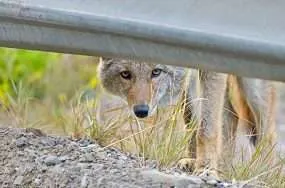
Just one example: The proliferation of small, cheap wildlife cameras has enabled researchers to amass tens of thousands of images that can take months of tedious work to catalog. Recently, AI tools have been some help, enabling scientists to, for example, sift out images containing no wildlife at all. But people are often still spending months scrolling through grainy snapshots before doing any of the “real” analysis. In computer parlance, there’s still a “human in the loop.”
That might not be true soon, however. AI-powered programs have grown sophisticated enough that in some cases they can screen and analyze wildlife camera data with enough accuracy that the final result isn’t meaningfully different from the more common labor-intensive approach, according to a new paper in the Journal of Applied Technology. In other words, no more human in the loop.
“We’re not trying to replace people,” said Washington State University wildlife ecologist Daniel Thornton, the study’s lead author. “The goal is to help researchers get to answers faster so they can make better decisions about managing and conserving wildlife.”
The new research didn’t involve some fancy technical breakthrough in AI programming. Rather, ecologists like Thornton collaborated with people at tech giant Google to see how they could harness existing AI tools. To do that, they set up what amounted to a competition: computers versus humans.
They started with nearly 3.8 million digital photos taken by 1,200 wildlife cameras in three different locations – eastern and central Washington state, Glacier National Park in Montana, and a jungle reserve in Guatemala. The photos had been scrutinized by experts to identify the species of any mammal that turned up. Then the researchers handed them over to AI.
First, they used MegaDetector, a program that detects whether animals, humans or vehicles are in an image. After that initial screening, the animal-positive images were turned over to SpeciesNet, a Google-developed program built to identify what animals are in a photo. It covers approximately 2,500 different groups of species from around the world. The results were then fed into a computer model built to convert these animal sightings into an estimation of where each species occurred on a landscape, what’s known as “occupancy.”
With the exception of a few outliers, the results from the automated AI approach weren’t very different from the analysis with a more human touch. The results aligned between 85% and 90% of the time.
It doesn’t mean the computers were perfect. Rare or hard-to-identify species sometimes tripped up the programs. SpeciesNet mistakenly classified mountain goats in Montana as domestic goats. Grizzly bears were reported in Washington, when they haven’t been there in decades.
But for many species in each of the three regions, the lightning-fast computers were as accurate as the plodding humans.
“The key question wasn’t whether the AI got every image right,” said Dan Morris, a scientist at Google who helped create SpeciesNet and is a co-author on the study. “It was whether the ecological conclusions you care about would end up being basically the same.”
If this approach finds its way out of academia, it could enable wildlife managers to get up-to-date information much more quickly about what’s happening to wild populations. Among other things, that could mean quicker alerts when an endangered species shows up somewhere, or if it’s starting to vanish.
“The big takeaway is that this doesn’t have to be a bottleneck anymore,” Thornton said of the image backlog. “If we can process data faster, we can respond faster, and that’s really what matters for conservation.”
Thornton, et. al. “Identification of camera trap images by artificial intelligence and human experts produces similar multi-species occupancy models.” Journal of Applied Ecology. May 6, 2026.
Image (based on) ©Smithsonian via Flickr