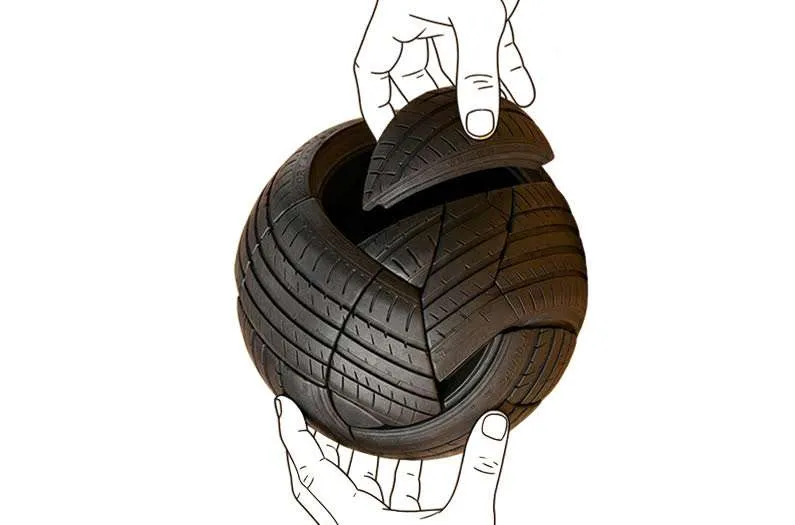
Researchers in Spain have shown that a modular tire in which tread and casing are designed as separate pieces stays together while in use, provided that it’s properly inflated.
“This is an encouraging step toward a more sustainable tire architecture, where the worn tread could potentially be replaced while the main tire structure is reused,” says study team member Farshad Afshari, a PhD researcher at Universidad Carlos III de Madrid (UC3M) and Universidad Politécnica de Madrid (UPM)..
A modular automobile tire could be easier to recycle compared to conventional ones, which require time- and labor-intensive separation of rubber treads and sidewalls from steel belts and bead cores. It would also use materials more efficiently, since there would be less material to replace at any given time.
A modular tire could also be better for the environment. Conventional rubber tires are a prominent source of microplastic pollution because tiny rubber particles degrade due to friction and enter the air and waterways. But the modular design could open up the possibility of making each component of the tire from safer and more easily recyclable materials.
It’s a compelling idea in theory, but would the components of a modular tire actually stay together in practice?
Afshari and his collaborators built a scaled-down prototype of their ECOTIRE modular tire concept, in which tread and casing are mechanically interlocked through a series of bumps and hollows like the two halves of a waffle iron.
They tested the tire on a custom-built rolling test rig in the lab to see how the tire would fare while varying parameters such as load, turning radius, inflation pressure, and slip. This last component is a source of mechanical stress induced by driving conditions such as braking and cornering.
“Our research shows that a tire with a replaceable tread can maintain a stable mechanical connection during rolling, even under demanding slip conditions, without relying on adhesives or permanent bonding,” Afshari says.
“One particularly interesting observation was how strongly inflation pressure influenced the stability of the connection,” he adds. At normal inflation pressure, the tire’s components stayed together under all conditions tested. But at half the normal pressure, the tread and casing could separate, especially under a combination of high load, tight rolling radius, and greater slip conditions.
The researchers tested the tire for over 12,000 revolutions, equivalent to more than 7 kilometers. At the end of the experiment there was no indication of wear and tear on the tread or the rest of the tire—promising albeit preliminary evidence of the tire’s durability.
In the prototype, both tread and casing are made from silicone rubber, but the researchers anticipate using a different material in eventual manufactured tires.
“The next major steps include developing full-scale prototypes using materials representative of commercial tires and evaluating their performance under more realistic driving conditions,” Afshari reports. “This would involve braking and traction forces, transient maneuvers, temperature variations, road irregularities, and long-term fatigue and wear.” Head-to-head tests with conventional tires will be another key milestone further down the road.
Source: García-Pozuelo D. et al. “Measurement of rolling stability and slip angle effects on a modular ECOTIRE.” Measurement 2026.
Image: ©Anthropocene Magazine.