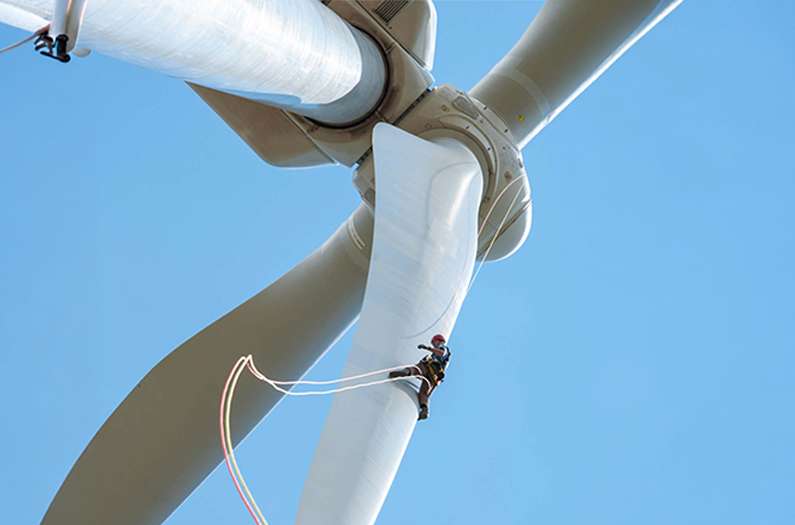
Wind turbines are designed to last for 20–25 years. By that measure, turbines around the world are an elderly lot. In the US alone, 7,500 wind turbines are at least 20 years old.
As these clean energy-generating behemoths approach the end of their lives, their green reputation gets tainted. That’s because their large blades end up in landfills. Made to withstand the elements, turbine blades are so durable that breaking them down to recycle them is also not easy.
But researchers at Tsinghua University have found a straightforward way to breathe new life into wind turbine blades. Their method turns old blades into two valuable manufacturing materials that can improve the mechanical and thermal properties of new blades.
This new approach cuts greenhouse gas emissions by 83–92% compared to present-day recycling technique. The results can be found in the journal Chem Circularity.
Wind turbine blades are made of tiny glass fibers in a resin that is made of chains that are linked closely. The fibers are difficult to separate from the resin for recycling. Existing recycling methods require rely on breaking down the resin with heat or chemical solvents. Besides consuming a lot of energy and producing chemical waste, these processes weaken the fibers and results in low-value materials.
The Tsinghua team ground blade waste into powder and mixed it with carbon black. Then they place the mixture between electrodes and blast it with short intense pulses of electricity, using a technique called Flash Joule Heating. The method creates intense heat, so that the powder reaches temperatures of 2000°C in half a second.
At these blistering temperatures, carbon reacts with silica to form silicon carbide, which is a tough, heat-resistant compound. Carbon atoms also reorganize into a one atom-thick lattice with a honeycomb structure, called graphene. Graphene, a material whose discoverers garnered the Nobel Prize, is known for its strength and ability to conduct heat and electricity.
The process converted close to 60% of the mixture into a silicon carbide–graphene composite made up of 34% silicon carbide and 66% graphene. The researchers then added this composite to fresh epoxy resin for making new blades. Just 0.3% by weight of the additive made the new resin stiffer and stronger, which should increase lifetime of new blades.
The researchers’ calculations also show that at commercial scale the new blade recycling approach could turn a profit of about $80 per ton of material because the recovered silicon carbide and graphene are valuable. Heat and chemical-based recycling methods, by comparison, cost $460 per ton and $1,800 per ton respectively, they say.
“Many emerging waste streams, including aerospace composites, automotive lightweight structures, electronic encapsulants, and fiber-reinforced construction materials, share similar challenges,” the team writes in the paper. Their approach hints at a way to deal with those waste streams. The team is now working on ways to scale up their process.
Source: Hao Bi et al. Upcycling of waste wind turbine blades by electrothermal reduction toward circular resin composite applications. Chem Circularity, 2026.
Image: Photo by Dennis Schroeder, NREL 27196