One of the most troubling paradoxes of trying to save endangered species is when other animals are killed. Wolves are shot in Canada to rescue ailing caribou. Barred owls are shotgunned in Pacific Northwest forests for the sake of their smaller cousins, the spotted owls.
Conservationists in Scotland have hit on another possible approach: Feeding predators to make them so fat and happy that they won’t bother killing a protected animal.
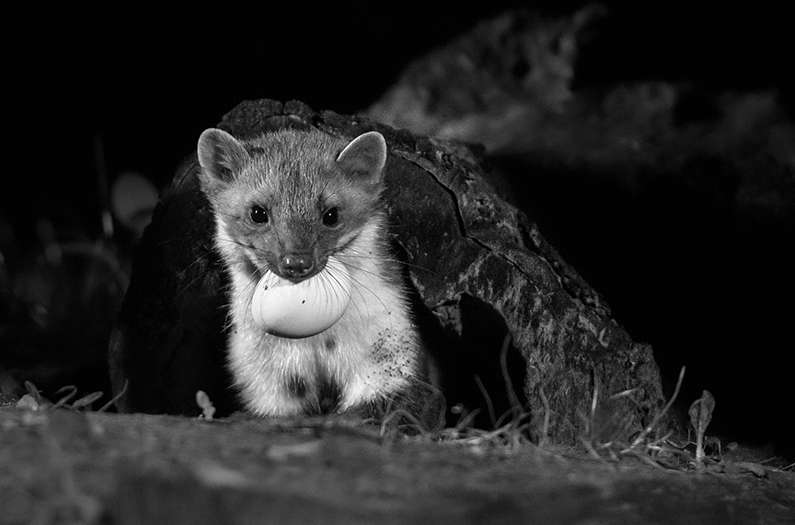
The strategy might provide a solution to a particularly thorny problem facing wildlife managers in the mountainous Cairngorms, a region in the Scottish Highlands. There, the once rare pine marten, a weasel-like animal, has made a celebrated comeback. But its rising fortunes have clashed with the perilous state of the region’s capercaillie, an impressively large ground-dwelling grouse. Martens feed on the eggs of the birds, which number less than 600 in the United Kingdom.
“Our idea was to fill the bellies of pine martens and other predators, like badgers, in capercaillie strongholds, predicting that once full of free food they would no longer search for eggs,” says Jack Bamber, an ecologist at the University of Aberdeen who took part in the research.
To test whether this would work, scientists offered the predators a tastier and easier meal – chunks of meat from deer killed to control their populations and help forests grow back (yes – this story still involves bloodshed).
They identified 30 spots with signs of nesting capercaillie and set up motion-sensitive cameras around patches of dirt where the birds gather to bath themselves in dust. Over the course of three years, during spring egg laying and hatching seasons, they alternated each site between having feeding stations supplied with 10-kilogram pieces of deer meat, and having no supplemental feeding.
A review of dust bath photos enabled the scientists to gauge whether or bird numbers changed when the deer meat was nearby.
The difference was dramatic – enough to determine whether the bird population rebounded or continued spiraling downwards. When there was no supplemental meat, hens were more than twice as likely to show up with no chicks. Roughly .8 chicks were predicted for each hen in that scenario. But when martens were supplied with deer meat, that number rose to 1.9 chicks per hen – translating into a positive growth rate for the overall bird population, the scientists reported last week in Proceedings of the Royal Society B.
By limiting the extra feeding to just 8 weeks during the critical spring nesting season, it might also avoid potential downsides, including fueling a population boom among martens, the scientists report.
The new research suggests that such feeding could be used to blunt the effects of predators in the Cairngorms and elsewhere. It could also offer a kinder, gentler way to manage such conflicts, at a time when attitudes are shifting about what conservation management strategies are ethical, says Bamber. Kinder, except perhaps for the deer.
Bamber, et. al. “Empirical evidence that diversionary feeding increases productivity in groundnesting birds.” Proceedings of the Royal Society B. June 25, 2025.
Image:© Rudmer Zwerver| Dreamstime.com