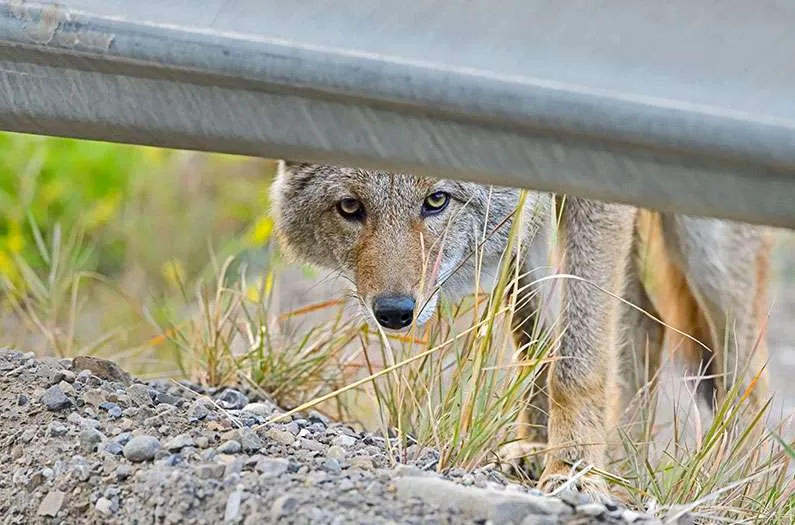
Coyotes, it seems, prefer the roar of the garbage truck to the call of the wild.
While pigeons, rats and cockroaches might be more emblematic city-dwelling wildlife, coyotes have shown an aptitude for urban living. In just the last year they’ve made the news for taking up residence in such places as West Hollywood, Chicago and suburban Miami. Their presence near cities is so routine that it takes something unusual to generate headlines.
Much as humans pack together in cities, it turns out coyotes inhabit at least one urban area at roughly 9 times the density they do in the wild, according to research in Washington state published recently in the journal Environmental Research: Ecology.
“That might surprise people who think of coyotes as afraid of humans, but I think it just shows how ideal the urban setting is for coyotes,” said Laura Prugh, a University of Washington wildlife ecologist who led the new research.
This isn’t the first time scientists have noted that cities boast higher concentrations of coyotes, nor is the phenomenon confined just to these canines. Other research has found that raccoons, red foxes and (improbably) leopards live in cities at densities five times that of their counterparts in the countryside.
But in the case of coyotes, much of the evidence is incomplete, without the scientific rigor that could get at just how coyote life varies between paved streets and remote forest.
To get a more accurate comparison, Prugh and her collaborators tracked coyotes through their scat. In 2021, they repeatedly scoured 34 green spaces in Seattle, such as parks and cemeteries, for feces left behind by coyotes. They did the same in forests and open country in a mountainous north central part of the state, some 120 miles away from Seattle.
All told, they gathered more than 800 samples. Genetic analysis told them the scat came from 48 different Seattle coyotes and 213 wildland coyotes.
While that might make it seem like there were more coyotes in the wild, that’s not adjusting for the size of the locations where they looked for scat. Relying on statistical techniques commonly used to estimate wildlife population demographics, the scientists found that urban coyotes were, in fact, much more closely packed together.
There are a host of reasons why coyotes might thrive more in a city. They are much less likely to encounter animals that prey on them, such as wolves, bears and mountain lions. Among radio-collared wolves in the wildland study area, 3 were killed by cougars and one by a black bear. Coyote pups were also killed by wolves.
While cars present a danger on city streets, armed humans bent on killing coyotes in rural areas might well be more lethal than any vehicles. Of the 47 collared wildland coyotes whose deaths could be confirmed, slightly more than half were killed by hunters or trappers. A single coyote was killed by a vehicle.
Then, there’s the urban smorgasbord of food. Between overflowing trash cans, fast-food burgers dropped in the gutter and ubiquitous urban bunny rabbits, Seattle coyotes have a far more diverse, and potentially much more abundant, food supply. The same research group found that coyote scat in Seattle contained genetic matches for more than twice as many species or groups of species than their wild counterparts±64 to 27.
Despite these results, coyotes appear conflicted about urban life. While there are more of them per square mile, the scientists found that when you compared different parts of Seattle, the places with the highest coyote density were the ones with the fewest people. They’re drawn to much of what the city offers, just not the humans that built it.
So how should we react to the idea that coyotes appear to thrive more in cities than in the wild? Perhaps acceptance or resignation are best. It’s repeatedly been shown that the animals defy efforts to control their numbers, said Prugh. We might just need to add them to the pantheon of urban animals.
“Whether there are too many or too few coyotes is sort of a societal question, but ultimately our answer might not matter,” said Prugh. “Coyotes are here to stay in cities, and it is up to us to learn how to live with them.”
Prugh, et. al. “Urbanization increases coyote density 9-fold in Washington state despite negative effects of human density within Seattle, USA.” Environmental Research: Ecology. Sept. 10, 2026.
Image: ©Robert McGouey/Alamy